What Is Game Juice? A Complete Introduction
Game juice is the accumulated layer of sensory feedback that makes player interactions feel satisfying, responsive, and alive. This is the definitive introduction to the concept every indie developer needs to understand.
28 April 2026 · 6 min read
You have felt it before. A game where every jump has weight, every hit lands with a satisfying crunch, and every explosion fills the screen with chaos. Compare that to a game where your character slides across the floor, attacks feel like pressing a button in a spreadsheet, and death is just a number going to zero. The mechanics might be identical. The difference is game juice.
The Core Definition
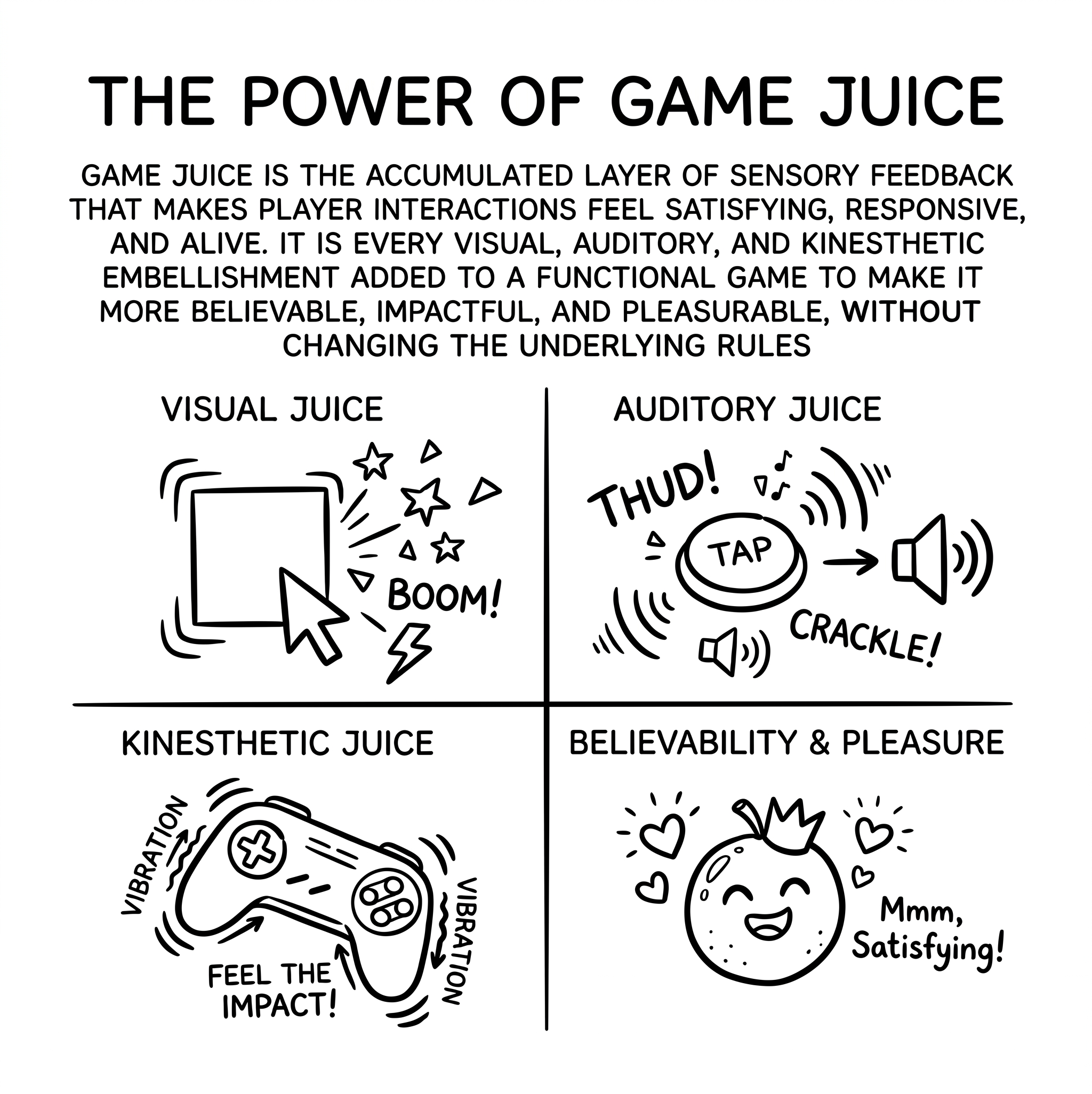
Game juice - also called game feel, polish, or juiciness - is the accumulated layer of sensory feedback that makes player interactions feel satisfying, responsive, and alive. It is every visual, auditory, and kinesthetic embellishment added to a functional game to make it more believable, impactful, and pleasurable, without changing the underlying rules.
Steve Swink, who wrote the definitive book on the subject (Game Feel, 2008), describes game feel as "the tactile sensation of manipulating a digital agent." It is the quality that makes Mario feel joyful to move, even if there are no enemies and no levels - just a character in an empty room.
The term "juice" was popularised by Martin Jonasson and Petri Purho at GDC 2012 in their legendary talk Juice It or Lose It, where they live-coded a Breakout clone and progressively transformed it - same rules, same mechanics - into something deeply satisfying through layered feedback alone. Every step of the way they added more: squash and stretch, screen shake, particles, trails, sound. At the end, two versions of the same game sat side by side. One was functional. The other felt alive.
The Fruit Analogy
The analogy is deliberate. A well-designed core game is the fruit. Juice is what you extract from it. You cannot make juice without good fruit first - applying polish to a broken core game only amplifies the brokenness. The juice must echo and reinforce what already exists.
This is the most important principle in all of game juice: juice serves the gameplay. Screen shake in a horror game can break immersion. Subtle secondary animation in a story-driven game can build it. Every technique exists in the context of the game around it. Context is everything.
Game Juice vs. Game Feel vs. Polish
These three terms are often used interchangeably, but useful distinctions exist between them. Game feel is the broadest concept - it is the entire tactile and sensory experience of playing, encompassing responsiveness, control, and physical sensation. Game juice is narrower: the specific embellishments layered on top of the core experience - particles, screen shake, sound effects, visual flourishes. Polish is broader again, covering all quality-of-life refinement including bug-fixing, smooth transitions, and careful detail work.
On this site, we use all three terms, but game juice is the organizing concept. It is the most actionable and the most teachable of the three.
Why Juice Is Not Just Cosmetic
The most common misconception about game juice is that it is decoration - something you add at the end, after the real work is done. This is wrong in a way that has real consequences for how games are built.
Juice is information delivery. Every piece of feedback tells the player something. A hit reaction tells them their attack connected. A screen shake confirms an impact. Damage numbers quantify the outcome. A sound effect distinguishes a critical hit from a regular one. Without this feedback, players cannot understand what is happening, cannot feel the consequences of their skill, and cannot enter the state of flow that makes games worth playing.
Juice also serves competence. Self-Determination Theory, one of the most robust frameworks in motivational psychology, identifies competence as a core human psychological need. Every screen shake, every explosion, every satisfying crunch communicates: your actions matter, you are effective, you are skilled. This is why juicy games feel good to play even when you are losing - the feedback keeps the sense of agency alive.
The Three-Channel Rule
One of the most practical frameworks in game juice is the Rule of Three: every meaningful game action should produce feedback in at least three channels.
Visual - particles, screen shake, color flashes, hit reactions, animation.
Audio - impact sounds, music stingers, UI feedback, ambient audio.
Kinesthetic - haptic feedback, animation weight, momentum, controller rumble.
A hit that makes a sound but produces no visual or physical response feels hollow. A hit with visual feedback but no sound feels sterile. A hit with both but no physical weight - no hitstop, no controller rumble - feels light. Stack all three channels and the same game event becomes a satisfying, complete sensory moment.
Five Games That Define Modern Juice
The best way to understand game juice is to feel it. These five games are reference points used throughout this site.
Celeste - the gold standard for platformer feel. Every jump, dash, and landing has precisely tuned visual and audio feedback. Nothing is wasted; nothing is missing.
Hades - combat juice in an action roguelite. Each weapon type has a distinct feel profile. The hit confirmation stack - sound, particles, screen shake, enemy reaction - fires on every successful hit.
Hollow Knight - weight and mastery. Controls that reward learning. The bounce on a successful nail strike is one of the most satisfying single interactions in recent game history.
Vlambeer's Nuclear Throne - the Vlambeer house style at its peak. Maximum feedback from every gun, explosion, and enemy death. Exaggerated without losing coherence.
Peggle - casual juice mastery from PopCap. The Ode to Joy fanfare on a final ball is one of the most studied game juice moments in the industry. Inconsequential mechanics made to feel momentous.
The Compulsion Loop and Why Juice Matters
At its core, game juice works by tightening the compulsion loop: Action - Feedback - Reward - Motivation to act again. Every layer of juice compresses this loop. A snappy hit sound makes attacking feel rewarding. That reward motivates the next attack. A chain of satisfying micro-rewards creates the moment-to-moment engagement that keeps players in the game.
This is not manipulation - it is design. The same mechanisms that make a game hard to put down also make it clear, readable, and communicative. A game with excellent juice is a game that tells you exactly what is happening at every moment, and makes you feel something about it.
Where to Start
If you are new to the concept, the next article in this series covers Steve Swink's 6 Components of Game Feel - the most rigorous taxonomy of what creates the feeling of playing a game. After that, the Visual Techniques series covers screen shake, particles, easing, and every other visual tool in the kit.
If you want a quick win today, start with the Game Juice Checklist - 30 specific techniques you can apply to any game, tiered by time investment.
Every article on this site is, in some sense, an answer to the question: what is game juice? This one is just the beginning.
Part of a series
Foundations